




711 – 1492 and beyond
The Moors
Not one nation but a civilisation: Black and melanated Berbers, Arabs, Sahelians and Judeo-Berber merchants who governed Iberia for nearly eight centuries and moved knowledge between three continents.
North Africa, the Sahel, Borgu, Mali and Iberia
All empires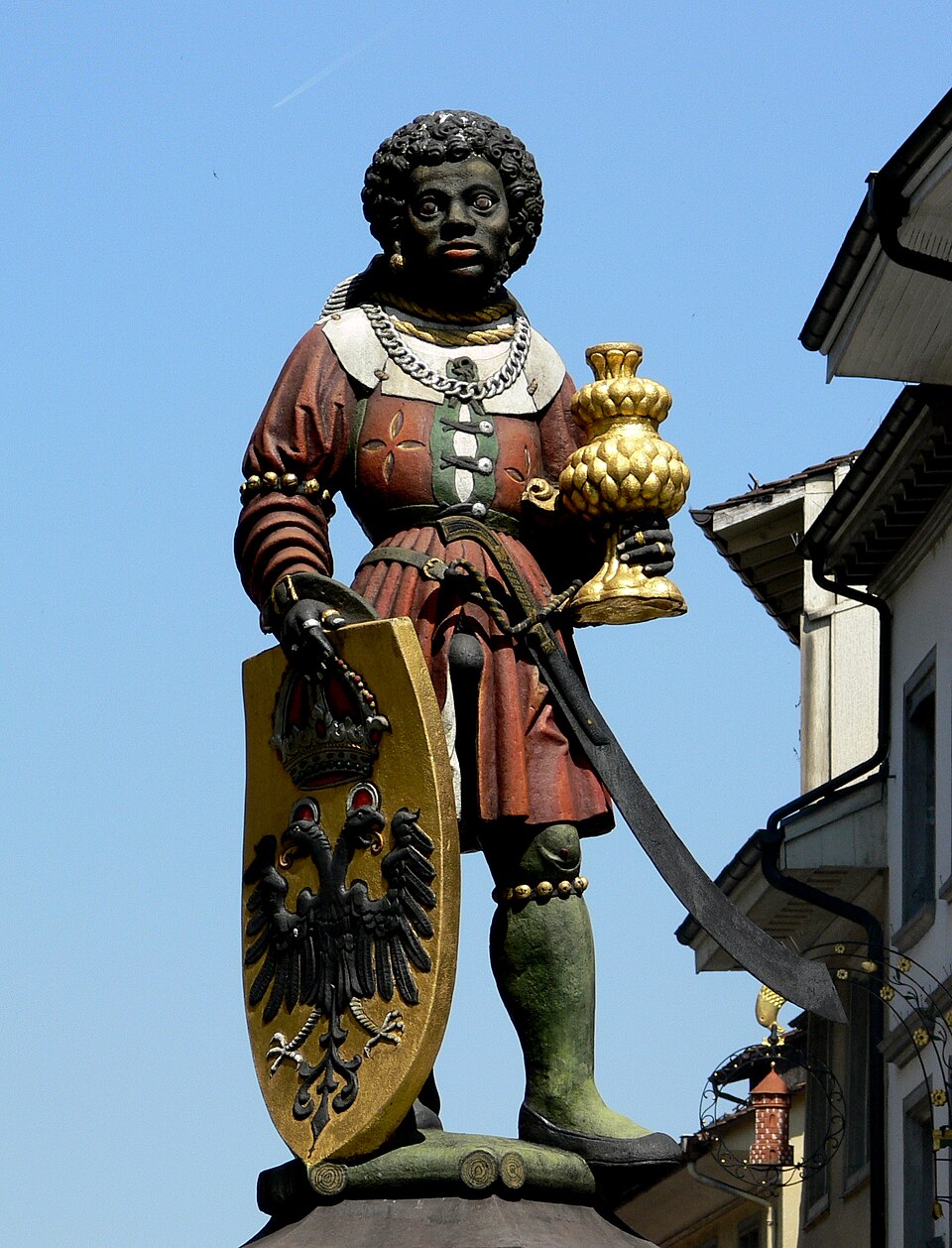
- Entry to Iberia
- Tariq ibn Ziyad crosses at Jabal Tariq — Gibraltar — in 711
- Capitals
- Córdoba, Seville, Granada; Fez, Marrakesh, Timbuktu
- Ended
- The fall of Granada, 1492, followed by expulsion and the Inquisition
- Legacy
- Paper, universities, algebra, optics, surgery, irrigation, citrus, the lute
Deep history
Who the Moors were
“Moor” comes from the Latin Mauri, the people of Mauretania in the Maghreb. It was never an ethnic category in the modern sense: it covered Amazigh Berbers, Arabs, Sahelian West Africans, Judeo-Berber communities and their descendants, bound by a shared trade and scholarly world across the Sahara and the Mediterranean. Medieval European sources describe them repeatedly as black or dark-skinned, and heraldry across Europe still carries the Moor's head.
Al-Andalus
Tariq ibn Ziyad landed in 711 and within a decade most of Iberia was under Muslim rule. Córdoba under Abd al-Rahman III became the largest city in Europe, with street lighting, paved roads, running water, public baths and a library said to hold four hundred thousand volumes at a time when the largest Christian libraries in Europe counted in the hundreds. Al-Zahrawi's surgical encyclopedia was the standard European text for five centuries. Ibn Rushd's commentaries on Aristotle reopened Greek philosophy to Latin Christendom. Ibn Firnas attempted flight in the ninth century. Convivencia, however imperfect and interrupted, allowed Muslim, Jewish and Christian scholars to work in the same institutions and translate each other's books.
Almoravids and Almohads
The Sanhaja Berber Almoravids swept out of the western Sahara in the eleventh century, founded Marrakesh, halted the Christian advance at Sagrajas in 1086 and unified Morocco with al-Andalus and parts of the Sahel. The Almohads followed in the twelfth century, raising the Giralda in Seville and the Koutoubia in Marrakesh. Both movements moved constantly between the Sahel and Iberia; the same families and lineages appear on both shores.
The Saharan network
Trans-Saharan caravans linked Sijilmasa and Ghadames to Timbuktu, Gao, Walata and Kano, carrying gold, salt, copper, books and scholars. The Radhanite Jewish merchant network reached Timbuktu, and merchant lineages known regionally as Wangara, Wakore, Dyula, Jakhanke and Wassangari in Borgu spread commerce and Islamic learning through West Africa. Excavations at Gao-Saney show ironworking and long-distance trade reaching towards Mesopotamia by around 700 CE.
1492 and the Atlantic
Granada fell in January 1492; Columbus sailed in August. The two events belong to one process. Moorish and Morisco navigators, translators and pilots — Pedro Alonso Niño among them — were on the early Atlantic voyages, and conversos fleeing the Inquisition were among the first non-indigenous populations moved into the Americas. Estevanico of Azemmour crossed the American Southwest in the 1530s. Expulsion scattered Moorish families across the Maghreb, the Ottoman lands and the Atlantic world.
What survived
Arabic loanwords fill Spanish and Portuguese; the Alhambra, the Mezquita and the Alcázar still stand; the acequia irrigation of Valencia is still administered by the water court the Moors established. In the Americas, Moorish identity resurfaced in the twentieth century in movements that read the historical record of Black North African and Sahelian presence in the pre-slavery Atlantic world.
Paternal lineages
E1b1b (E-M81) reaches its global peak in the Maghreb and remains present in Iberia; E1a (E-M33) and E1b1a mark the Sahelian component of the Moorish world, alongside J1 and Iberian lineages.
Other empires
Kemet
c. 3150 BCE – 30 BCE
Egypt & Nubia, the Nile Valley
Axum
c. 100 CE – 940 CE (roots to D'mt, c. 980 BCE)
Ethiopia & Eritrea, the Horn of Africa
Mali Empire
c. 1235 – 1670
Western Sudan — Mali, Senegal, Guinea, Gambia, Mauritania
Oyo Empire
c. 1300 – 1896
Yorubaland — south-western Nigeria and Benin
Kongo Empire
c. 1390 – 1914
Central Africa — DR Congo, Republic of Congo, Angola, Gabon