




c. 1235 – 1670
Mali Empire
The Manden Kurufaba: a federation founded on a sworn charter of rights, funded by two-thirds of the gold circulating in the medieval Old World, and remembered by the griots who have recited its constitution for eight centuries.
Western Sudan — Mali, Senegal, Guinea, Gambia, Mauritania
All empires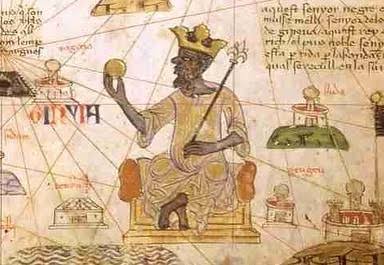
- Founder
- Sundiata Keita, after the battle of Kirina, c. 1235
- Charter
- The Kurukan Fuga, an oral constitution of the Manden, 1236
- Capitals
- Niani, later Ka-ba and Dakajalan
- Cities
- Timbuktu, Djenné, Gao, Walata, Kangaba
Deep history
Wagadou before Mali
Mali rose on the bones of Wagadou, the empire Arab writers called Ghana, which controlled the gold-salt exchange from perhaps the fourth century and whose capital Koumbi Saleh held tens of thousands. Al-Bakri in 1067 described a court where the king held audience in a pavilion surrounded by horses in gold cloth, guard dogs in collars of gold and silver, and princes with gold plaited into their hair. When Wagadou fragmented, the Sosso under Sumanguru Kanté took the Manden.
Sundiata and Kirina
Sundiata Keita, the exiled son of Naré Maghann Konaté, returned with an allied army and broke Sumanguru at Kirina around 1235. The Epic of Sundiata, carried by the jeli families of the Kouyaté, Diabaté and Kanté since that day, is one of the great works of world literature and was transmitted entirely by voice.
The Kurukan Fuga
At the gathering of Kurukan Fuga in 1236 the clans of the Manden agreed a charter: the abolition of slavery by raid within the federation, the inviolability of human life, the right of every person to speak in assembly, obligations of hospitality, protections for women and for the environment, and the division of powers among sixteen clans of quiver-bearers, five of marabouts and four of jeli. It is among the oldest recorded constitutions in the world and is inscribed on the UNESCO list of intangible heritage.
Mansa Musa
Musa I, the ninth mansa, made hajj in 1324 with a caravan reported at tens of thousands of people and camels loaded with gold. His spending in Cairo depressed the price of gold across the Mediterranean for years. He returned with the Andalusian architect Abu Ishaq al-Sahili, who worked on the Djinguereber mosque at Timbuktu, and endowed the schools that grew into the Sankoré tradition, where manuscript copying, astronomy, jurisprudence and medicine were taught and where hundreds of thousands of manuscripts survive today. Musa appears on the 1375 Catalan Atlas holding a gold nugget, the image by which Europe knew Africa's wealth.
Abu Bakari II and the Atlantic
Al-Umari records Musa's account of his predecessor, who equipped two hundred ships and then two thousand more and sailed west into the Atlantic to find its limit, never to return — the reason power passed to Musa. Whatever the outcome, the account documents an African state with the shipbuilding, provisioning and ambition to attempt an ocean crossing two centuries before Columbus.
Decline
Fifteenth-century succession disputes, Mossi raids, Tuareg pressure on Timbuktu and the rise of Songhai under Sonni Ali and Askia Muhammad stripped Mali of its provinces. Portuguese caravels reaching the coast moved trade from the desert to the sea. The Manden survived as smaller kingdoms into the seventeenth century, but the memory never lapsed: the jeli still open with the same words.
Paternal lineages
E1b1a (E-M2) predominates among Mande populations, with E1a (E-M33) at some of the highest frequencies on earth in Mali and Guinea and E1b1b along the Saharan margin.
Other empires
Kemet
c. 3150 BCE – 30 BCE
Egypt & Nubia, the Nile Valley
Axum
c. 100 CE – 940 CE (roots to D'mt, c. 980 BCE)
Ethiopia & Eritrea, the Horn of Africa
Oyo Empire
c. 1300 – 1896
Yorubaland — south-western Nigeria and Benin
Kongo Empire
c. 1390 – 1914
Central Africa — DR Congo, Republic of Congo, Angola, Gabon
The Moors
711 – 1492 and beyond
North Africa, the Sahel, Borgu, Mali and Iberia